

Parrot Jungle fans flock for final look
Park's hours to change Sept. 2
BY EUNICE SIGLER
The Miami Herald
Posted on Sun, Aug. 25, 2002
The South Florida landmark is preparing for its December closing by changing its schedule to weekend hours beginning Sept. 2. The facility's Watson Island site is expected to be ready in the spring. Story, X.
As Parrot Jungle gets ready to move out of Pinecrest to new digs on Watson Island in December, people are flocking to the historic bird attraction to catch one last glimpse of the local landmark.
Mike De Santis took the day off Tuesday and, at the request of his children, Tony, 7, and Melissa, 9, trekked all the way from Weston for a final visit to the Pinecrest site that has been home to the attraction since 1936.
"They said, 'Let's go back before it closes,' " De Santis said. "It's part of Florida history -- I was here when I was their age. It's been here so long, you don't know what to expect of the new one."
Lisa Szekely from Cooper City brought her nieces, Aleah, 7, Haley, 6, and Kamryn, 4 months, for a day trip -- also for one last look.
"I think Watson Island is actually a nice idea," she said. "But I want to see it again before it closes."
Park administrators say they've seen a surge in attendance lately since word has gotten out that starting Sept. 2, the site will be open only on weekends.
"Initially, we had intended on closing many months ago -- and on Sept. 2 for good -- but with construction [at Watson Island] being delayed with the rain and everything else, we thought it would be better to just close our seven-day operation first," said Barbara "Bobbie" Ibarra, the park's general manager.
And it seems the public is grateful for that.
Ibarra says most phone calls she gets these days are from people who want to make sure they still have time for a final peek.
Even employees have been finding themselves a bit nostalgic lately.
William Sanchez's eyes moisten as he thinks about leaving the historic, 14-acre site at Red Road and Southwest 110th Street.
"When I got here, they taught me everything," said Sanchez, a Parrot Jungle worker for 27 years.
As assistant horticulturist, he keeps the tropical landscaping in tip-top shape.
"I loved the Christmas parties here. We used to play bingo," he said. "We used to get a lot of people from Canada and from South America in the summer. Now we get a lot of the kids from the schools."
It's the ambience he says he'll miss most.
"I'll miss the park, the cafeteria, the people -- everything we enjoyed," he said.
"I get emotional when I see [the birds] riding bikes, skating," said Elpidio Matos, who feeds and takes care of the animals. "We'll get used to it, but it will be different."
The park's promoters say the Watson Island attraction, to be called Parrot Jungle Island, will have a little bit of old and a lot of new.
The $47 million attraction is expected to open in the spring on 18.6 acres on the north side of the MacArthur Causeway, between downtown Miami and South Beach. It will still have a Parrot Bowl, and roller-skating and bike-riding birds, but it will also have a serpentarium, a jungle theater and an Everglades habitat.
Where Parrot Jungle now has about 1,000 varieties of plants, 500 birds and about 300 reptiles, primates and other animals, the new attraction will boast more than 1,200 animals, and more than 1,000 species of plants.
Jeff Shimonski, the park's director of horticulture, has been working for years preparing huge trees to be moved and taking cuttings from Parrot Jungle plants.
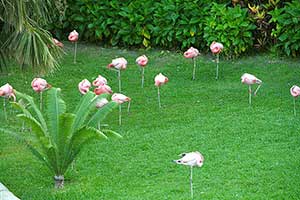
"We're in a sense replicating a lot of things," he said. "We're going to replicate Flamingo Lake, but what we're going to do is replicate the feel of the park."
He disagrees with people who tell him it can't be done.
"It's doable," he said. "In February 1977, we had a freeze that killed everything to the ground practically. People said we would never open again. Well, we came back. After Hurricane Andrew, people said we wouldn't be able to save the trees. Well, we did.
"We have moved over 80 trees onto [Watson Island] and we've had 100 percent success. To do that with that kind of success is unusual, but that's based on our experience at Parrot Jungle," he said.
But even with the excitement and challenge of re-creating Parrot Jungle's charms in an island setting ahead, Shimonski also finds himself already missing the park that once was the site of a nudist colony before Franz Scherr signed a lease on it in 1935.
The history books say the nudists had to move out after their neighbors became outraged, and the site lay vacant for years.
Thus, Scherr was able to lease the property, with the understanding that he would build a bird attraction there, for $25 a month.
It soon became the world's first "parrot jungle," drawing the likes of Winston Churchill to admire the free-flying birds.
Shimonski, who has been with the park since 1975, was out strolling through the gardens at 6:30 a.m. recently, feeling ``bittersweet emotions."
"There are a lot of plants there that I grew from seed," he said. "But when you can't really control something, you have to kind of go with it."
Others say they'll hang on to their memories, even if they can't hang onto the park.
Like Ruby Seays, who started working there in 1978 as a cleaning lady when the Scherr family still owned it. Through the years, she worked in the gift shop and other departments, and now is a ticket taker at the front gate.
She remembers the time a parrot pecked a large diamond from a woman's ring -- then swallowed it -- while the woman was posing for a picture with the bird.
She says the trainer told the woman: "We know all about birds, don't worry, you will get your diamond," then put the bird in a cage by itself so they could watch it over the next few days.
"Sure enough, out it came. The lady came back and picked up her diamond the next day," Seays said.
 About Theme Parks, Zoos & Tropical Design
 Integrated Pest Management in a Zoological Theme Park, Wing Beats the Journal of the American Mosquito Association
 The Environmental Lawn
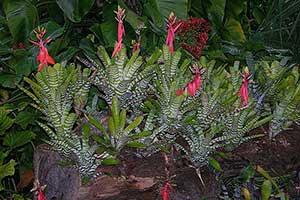 Design with Integrated Pest Management
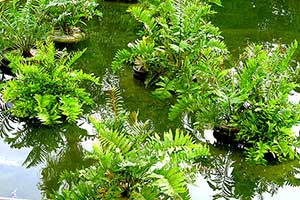 Creating Islands in Aquatic Ecosystems
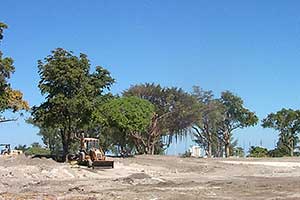 Building a New Jungle - Contouring the Site and Creating a Tree Canopy
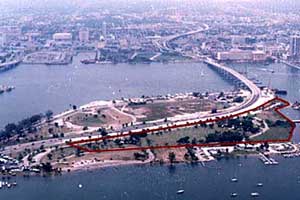 Watson Island - Remaking History
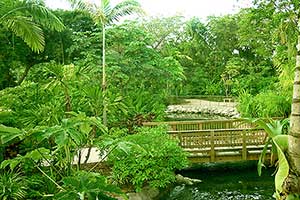 The Gardens at Parrot Jungle Island, The First Year
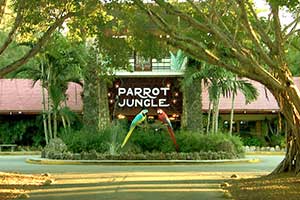 Parrot Jungle & Gardens