

The Gingers of Peninsular Malaysia
The group of plants commonly known as “ginger” is a prominent component of tropical floras throughout the world. They are used as ornamental plants for gardens, for traditional medicine, and in culinary preparations as a spice. Mostly terrestrial, they are found growing naturally in damp, shady areas but some species can tolerate full sun. There are also epiphytic species of ginger. Hedychium longicornutum is often encountered growing on the trunks of palms and trees in Peninsular Malaysia.
It is the floral structure or inflorescence of these plants that makes them so attractive in a tropical garden or as cut flowers. The gaudy, plastic looking floral structure is usually red, yellow, or orange, sometimes white. Most Asian gingers are thought to be butterfly or moth pollinated and the fruit is bird or animal dispersed. Some of the gingers that fruit close to the ground may actually utilize ants as fruit dispersers.
The order Zingiberales currently has within it eight families of which, the Zingiberaceae or ginger family is one of the largest families and is predominantly found in tropical Asia. Of the approximately 1200 species of plants found in the Ginger family about 1000 occur in tropical Asia. The richest area floristically is the Malesian region; a distinct zone that includes Malaysia, Indonesia, Brunei, Singapore, the Philippines and Papua New Guinea. About 160 species of Zingiberaceae occur in Peninsular Malaysia.
Further reading:
- Gingers of Peninsular Malaysia and Singapore, K. Larsen, H. Ibrahim, S.H. Khaw, and L.G. Saw, Natural History Publications (Borneo), Kota Kinabalu, 1999
- Gingers of Sarawak, Axel Dalberg Poulsen, Natural History Publications (Borneo), 2006
- Etlingera of Borneo, Axel D. Poulsen, Natural History Publications, 2006
Photo Gallery
Click Photos to Enlarge
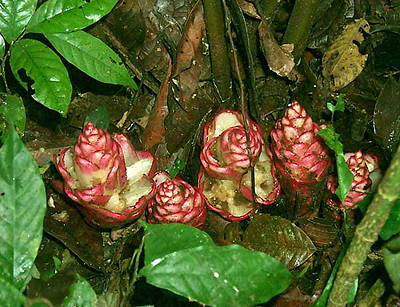
Zingiber sp.
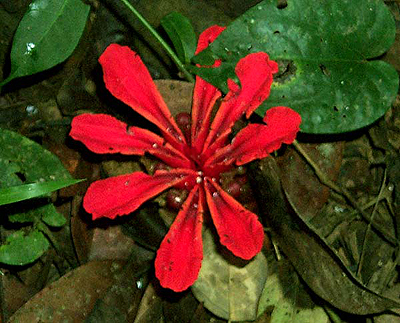 Etlingera littoralis
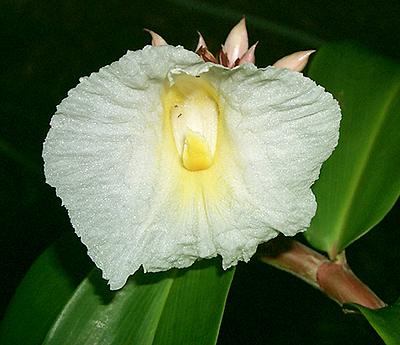 Costus speciosus
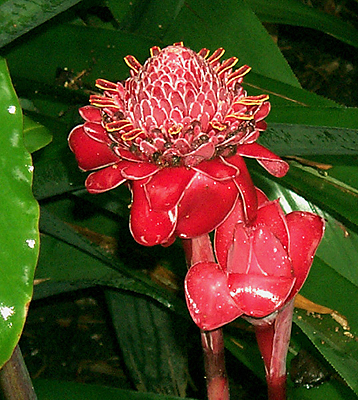 Etlingera elatior
 The inflorescence of Zingiber spectabile changes from yellow to red when fruit have set and are viable.
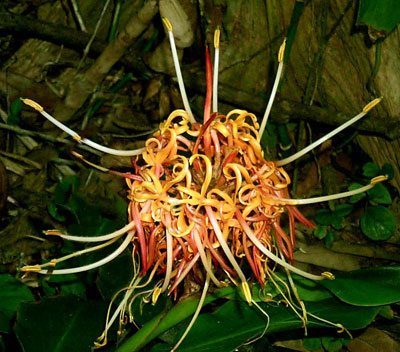 Hedychium longicornutum grows as an epiphyte.
click to enlarge
Hedychium longicornutum grows as an epiphyte.
click to enlarge
 About Plants of Malaysia & Borneo
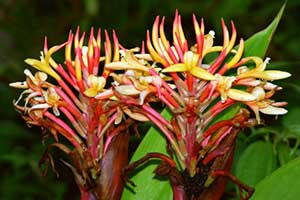 The Gingers of Kinabalu Park in Sabah, Malaysian Borneo
 Nepenthes rajah from Mt. Kinabalu, Sabah, Malaysia
 The Gingers of Peninsular Malaysia