

About Hurricane & Typhoon Tree Recovery
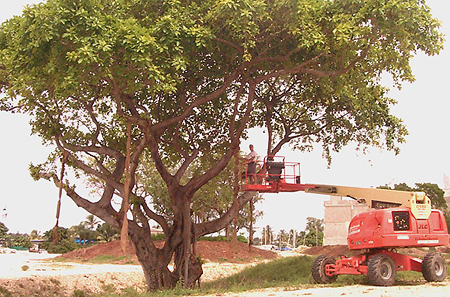
The lush tropical tree canopies that shade our homes, parks, and cities are often taken for granted. While trees always seem to grow slowly when first planted, eventually they become large mature specimens usually much appreciated for the shade they provide and the verdant foliage and/or fruit they produce. When planted in the wrong location or if a building, road, or other type of structure was constructed too close to a large tree, hazardous conditions often result. Root systems that are seeking a source of water or merely the large size of the tree canopy if allowed to reach unchecked proportions near vulnerable structures can cause great damage when blown over.
The aftermath of a Hurricane or Typhoon always seems like a total disaster. Damaged buildings, property, and landscape usually appear to be ready for the bulldozer and giant tub grinder. But when a more comprehensive site assessment of the landscape has been done, many landscape trees, shrubs, and palms are not only salvageable but great candidates for restanding and recovering to flourish once again. Large specimen trees that have been standing for years and have withstood many gale force winds can eventually succumb to windthrow and get blown over. The process of assessing damage and preparing a recovery plan should also be a process of improving the horticultural conditions in the landscape. Often trees are planted in holes that were dug improperly or too small. Planting conditions in tropical and subtropical areas can require that holes be dug into limestone or other unfavorable soil conditions. These unfavorable conditions leave landscape trees very vulnerable to windthrow. The roots of the tree can not penetrate the sides or bottom of the planting hole and eventually grow out of and over the original hole resulting in a very shallow root system. Often these trees fall with much of their root system still in place and functioning. These are great candidates for standing back up.
This section of the Tropical Designs of Florida website shows some of the means and methods that I have successfully utilized to save large fallen trees that have succumbed to windthrow or otherwise been damaged by hurricanes from Hurricane Andrew in 1992 to Hurricane Wilma in 2005. Horticultural techniques to prevent or reduce the possibility of windthrow are also documented and explained. Something to always remember is that much or perhaps most of the damage that has occurred from falling trees and branches could have been prevented. Proper plant selection, correct methods of plant installation and cultivation, and a good arboriculture plan will prevent much future damage and enable us to maintain the landscapes we aspire to cultivate.
Jeff Shimonski
2006
Photo Gallery
Click Photos to Enlarge
Starting aerial roots on the Banyan Tree, Ficus benghalensis, at Parrot Jungle Island in 2002.
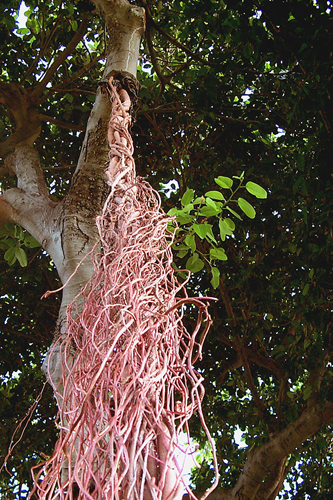 Banyan Tree aerial roots two years later growing vigorously.
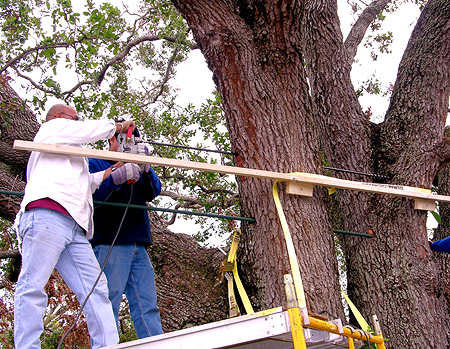 Drilling to place 7' long threaded rods to support a large Live Oak, Quercus virigiana, damaged in Hurricane Wilma
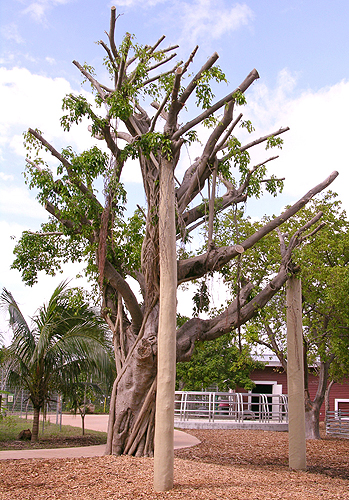 Poles installed on Ficus benjamina raised after being blown down in Hurricane Katrina.
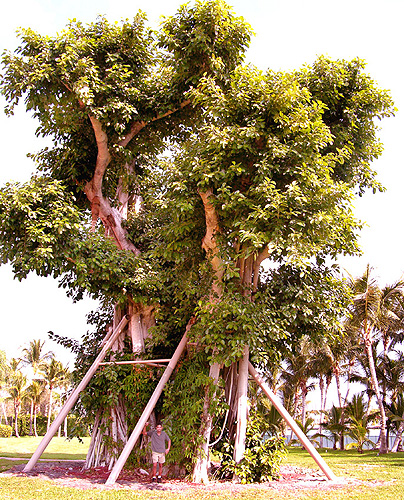 This Ficus altissima was blown down in Hurricane Wilma. It is now supported by steel columns until induced aerial roots take their place. This beautiful specimen tree greatly enhances the value of the property. The cost of the support structure is minimal when the tree's overall value to the property is taken into account.
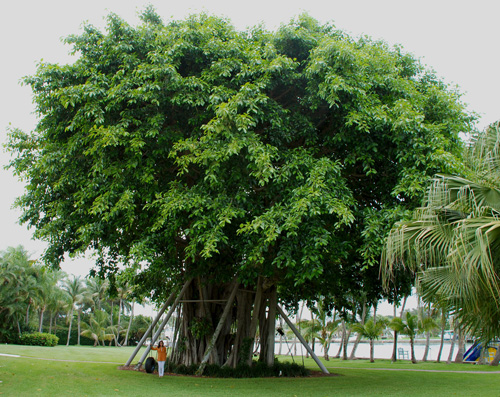 This ficus is recovering well in 2011 after being blown
down in Hurricane Wilma in 2005. Many new aerial roots have reached the ground and are starting to grow into trunks.
This ficus is recovering well in 2011 after being blown
down in Hurricane Wilma in 2005. Many new aerial roots have reached the ground and are starting to grow into trunks.
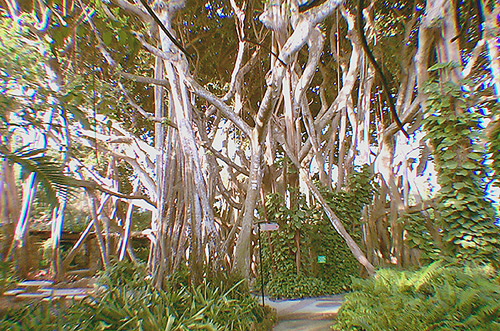 Mature aerial roots on a Ficus altissima that were artificially induced 40 years ago.
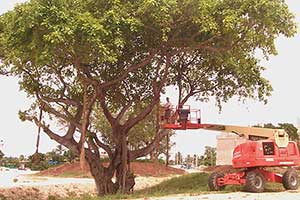 About Hurricane & Typhoon Tree Recovery
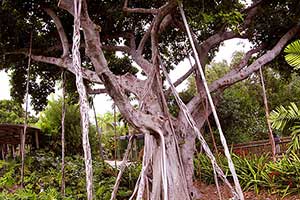 Ficus Species & Hurricane Horticulture
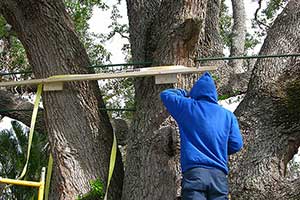 Hurricane Tree and Palm Restoration
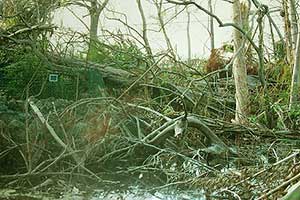 Saving Large Fallen Trees after Hurricane Andrew