

Relocating A Theme Park With A Compost Foundation
Journal of Composting & Organics Recycling, December, 2002

Florida theme park produces own compost for container mixes and topdressing, and most recently, in the transformation of a barren island into a new location.
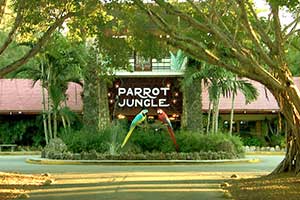
PARROT Jungle and Gardens (PJ) has been operating since 1936 in South Miami, Florida. Historically, the success of PJ has been based upon its collection of parrots and flamingos, its colorful parrot show, and the lush and highly manicured tropical gardens. Since 1988, when the park was purchased from the original founding family, the new owner has been adding different species of animals and more shows. The collection of tropical plants (species-wise) has tripled in number to approximately 1,000. Hundreds of species of tropical plants are grown in an outdoor setting year round. There is also a one-acre plant nursery on-site for growing new and replacement plants for the park.
Almost 15 years ago, I began to experiment with different Integrated Pest Management (IPM) practices. The use of restricted pesticides, fungicides, and nematicides has been reduced to the point where no restricted chemicals have been used since 1994. A considerable reduction in commercial fertilizer use also has been achieved. The major components of this program have been the adherence to specific cultivation techniques, such as selective pruning, closely monitored irrigation, and the use of mulch and our own park-produced compost.
The majority of plants that are containerized have straight compost as a potting medium. Other mixes include peat moss, perlite or pine bark, depending on the species of plant. We have found that commercial mixes break down, causing the roots to rot because water stays in pot. In general, compost helps control moisture, which in turn cuts down on irrigation. And we fertilize less, which makes nutrients less available to insects. Overall, the IPM program has enabled natural predators to survive. We haven't sprayed for spider mites in the park for about ten years; previously, the beds were sprayed ten to 15 times per year.
There had always been a rudimentary compost pile at PJ, primarily to reduce trash-hauling costs of animal-derived wastes and bedding. The compost was only used as fill. In 1993, the Department of Environmental Resources Management (DERM) of Miami-Dade County was going to make us remove the pile permanently because of regulatory issues. About this time, I completed the Municipal Compost Management course with Cornell University and was able to get a composting license for PJ in my name. Gradually, compost became a cornerstone of our IPM program. It is used as a soil additive throughout PJ and as the main component of the potting soil in the plant nursery.
All organic material (except food scraps) produced park-wide is composted (aerobically in a single windrow) next to the plant nursery. Feedstocks include plant and animal residuals, plus soiled sand from the petting zoo. Piles are turned every three to four weeks with a front-end loader. During the winter months, they are turned less frequently. A contractor brings in ground tree trimmings, which are thermophilically treated and used as mulch. Without the composting operation, I estimate that PJ would be filling a 20-yard dumpster each week that would have to be hauled away, as we are constantly pruning and cutting back foliage at the park. In 2001 our composting program at PJ won the Environmental Business Practices Award with the Greater Miami Chamber of Commerce.
Rebuilding Soils At New Site
The original PJ site, now surrounded by very high-priced homes, will be closing when a new location opens on Watson Island in the Spring of 2003. The challenge is that Watson Island is an 86 acre manmade "spoil" area created in the early 1900s from sand and rock dredged up from the creation of ship channels at the adjacent Port of Miami. The soil consisted mostly of a calcareous-quartzite material with little organic matter, which raised the issue of whether or not it could be used for intensive landscaping.
Since the site was only six to eight feet above sea level and considered a flood zone, all structural pads had to be raised to 12 feet above sea level. The top four feet of almost the entire site was stripped off and stored for landscape fill. Dredgings from the ship channels at the nearby Port of Miami were used for structural fill. That base was covered with the landscape fill; compost produced at the original PJ site was used as a soil additive. As part of the transition to the new 18-acre site, compost also has been used to create hundreds of feet of berms as extra growing areas for plants that are now being relocated.
Before construction began on Watson Island, about 150 trees were growing on the site. Many were large (up to 3 feet diameter at breast height) canopy trees that had been on the site for 20 to 30 years. Large canopy trees have been an integral part of the garden at the original PJ site, helping to keep the temperature at ground level cooler. It was decided to save and utilize as many of the original trees as practical. Utilizing existing trees from the site also would give the garden a more finished look when the new Park opens next year.
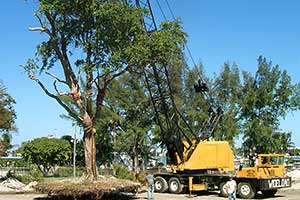
About 80 of the island's trees were in good enough condition (or were not considered invasive exotics that would have to be removed) to be considered for relocation. The trees were relocated to a holding area adjacent to the construction site. Once the site was contoured and landscaping areas prepared, the 60 largest trees were brought back -- all receiving a four to five inch topdressing of compost over the top of the entire root pad one month after planting. These root pads were from 15 to 25 feet in diameter and up to six feet deep. The compost was never placed against the trunk of the tree and never higher than the root collar, since that could cause rot problems.
After compost applications, two to three inches of well-broken down tree trimming mulch were laid on top of the compost to reduce the temperature of the soil surface thereby minimizing evaporation. All other landscape areas are being heavily mulched as well. Our goal is to improve water holding capacity, reduce weeds that compete with the landscape plants for water and nutrients, and generally, add organic material to the soil.
Several months later, the second set of trees was brought onto the site and installed in permanent locations. These trees and many others since brought in from other locations have received a topdressing of compost and mulch over their root balls. About one month after the compost is applied, the trees are lightly fertilized with 4-7-5 fertilizer.
Rapid Growth of Roots
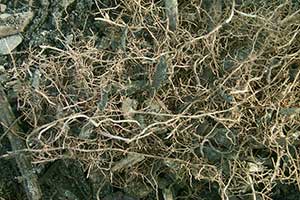
One positive result noticed within a couple of months after the compost application on top of the root balls was the rapid growth of hair roots. These tiny roots are so thick that on certain species of the faster growing trees, the entire layer of compost can be cut and peeled back, exposing the surface of the old root ball. In addition, the foliage on all of the trees is healthier (greener) and larger than the foliage on the trees before they were moved. Throughout the process of root pruning, excavation, and moving the 80 trees, I never noticed any earthworms in the root pads. Now the top composted layer and the adjoining layer below host a population of earthworms -- a very good indicator of a healthy soil. All of the trees from both mobilizations now seem to be well established. Composting and mulching are being done to all canopy and subcanopy trees being planted at Watson Island with excellent results.
Jeff Shimonski has been with Parrot Jungle and Gardens since 1975. In 1988, he became the Director of Horticulture.
Photo Gallery
Click Photos to Enlarge
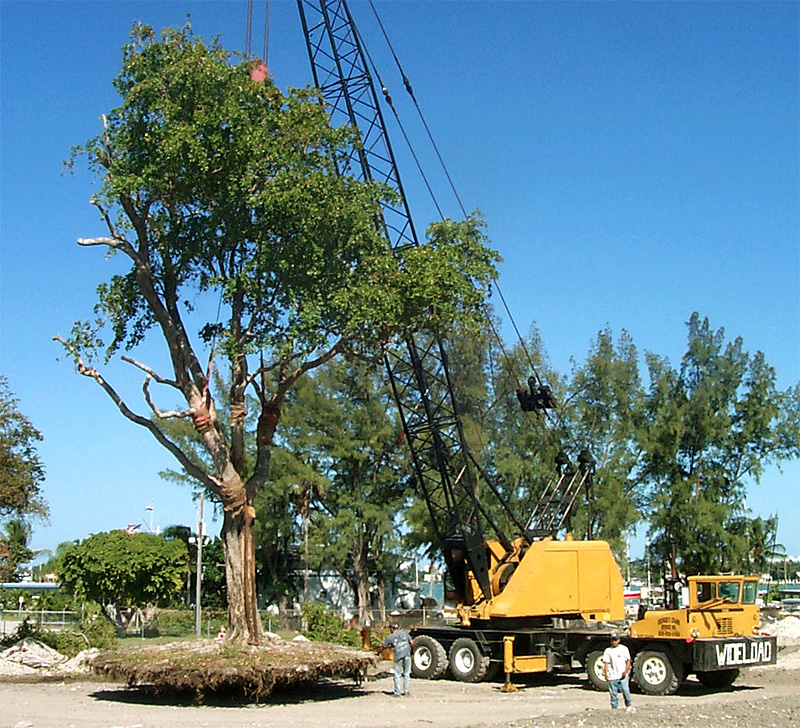
As part of its goal to save as many original canopy trees as practical, this 40,000 pound black olive tree was relocated and given the full "compost treatment".
 About Compost, Mulch & Tilth
 The Lattice Stinkhorn, It’s Slimy and It’s Smelly
 Relocating A Theme Park With A Compost Foundation
 How the use of Compost and Mulch has been an Important Component of a Successful Integrated Pest Management Program
 Composting at Parrot Jungle and Gardens