

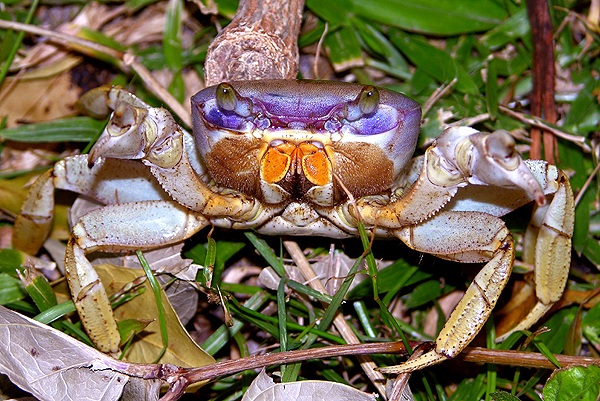
American Blue Land Crab
Those of us who have lived in South Miami over 20 years can remember the land crab migrations over Old Cutler Road.They would cross the road in such great numbers that traffic would have to slow down to a crawl.
If you accidentally ran a crab over your tire would be punctured by one of their overgrown claws. These curious creatures are now on the verge of becoming history. Over development has destroyed most of their unique habitat and the fact that some cultures consider them a culinary item has not helped their dwindling population, either.
The Blue land crab, sometimes called the American land crab, is the largest species of land crab in the Gulf of Mexico and Caribbean. Known scientifically as Cardisoma guanhumi, it naturally occurs on the east coast of the Americas from Florida to Brazil and is also found on Bermuda and many of the islands in the Caribbean. There are five other species of land crabs in the genus Cardisoma and they are found throughout the tropics, from the east and west coasts of Africa to the Pacific coastal regions.
Although these crabs appear to be completely terrestrial, they actually have modified gills. They require water to "breathe" and when on land they carry their own supply. Blue land crabs live in burrows that go down to the water table. These excavated burrows, which have been recorded up to ten feet deep, are sometimes their only source of water in arid areas.
The familiar migrations of the Blue land crab begin at the onset of the rainy season. This sometimes long (up to four miles from the ocean) and always dangerous trek is undertaken by the females in order to release their larvae in the ocean. Many animals, such as raccoons, foxes, and hawks consider these crustaceans food items and prey upon the exposed crabs that no longer have their burrows to dive into at the first sign of danger. (The larvae are also a source of food for fish and other aquatic animals).
The breeding cycle of the female crab coincides with the lunar cycle, with major migrations preceding full moons and minor migration preceding new moons. Breeding between males and females occurs one to two days before the full or new moon and development of the fertilized eggs takes about 16 days. The minute percentage of larvae that have survived their planktonic stage come to shore as megalops (baby crabs) after 30 to 40 days in the ocean.
A hard exoskeleton protects land crabs from the environment and most predators. Once a year the Blue land crab seals itself in its burrow for two or three months and molts its exoskeleton. This process, technically known as ecdysis, is how the crabs grow. The old exoskeleton is shed and, before a new one forms, they inflate their body by absorbing water, thereby increasing their size. The new exoskeleton then begins to grow. Blue land crabs molt once a year and do not appear to grow dramatically each time. In one study a large land crab with a carapace (the large shell on the top) that measured nine centimeters wide (or almost four inches in diameter) has been estimated to be 20 years old.
Food for the Blue land crab is mostly plant material. However, they have been known to eat other things such as carrion and animal feces. In some areas they have become agricultural pests because of their fondness for young plant shoots. Areas where these crabs occur are characterized by a lack of seedlings or plant debris. The voraciousness of the crabs actually is a selective factor for the types of vegetation in the habitats where they occur (they do not eat all vegetation, possibly because of plant toxins) and it has been theorized that where land crabs occur, exotic plant species are unable to become established.
These odd creatures that once numbered in the millions and impressed all with their massive migrations are now only plentiful in a few locations in South Florida. Hopefully they will be protected for future generations and be allowed to continue to occupy their niche as nature's recyclers.
Photo Gallery
Click Photos to Enlarge
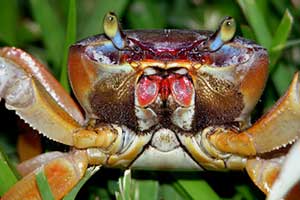
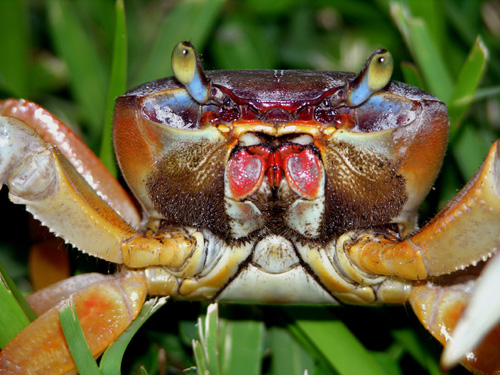 A close-up photo of a young female Blue Land Crab, Cardisoma guanhumi in defensive posture.
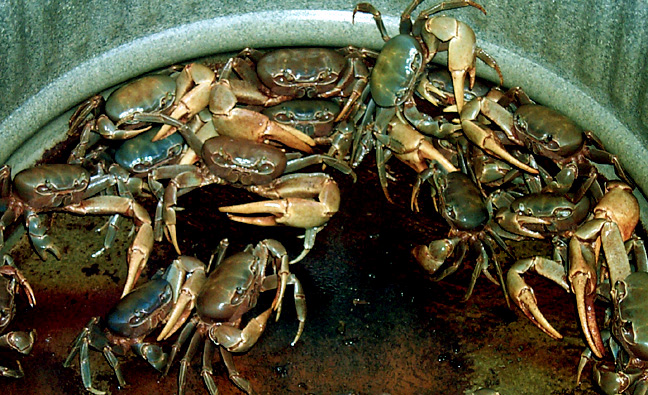 Collected land crabs
Cardisoma guanhumi after a rainy day in South Florida
Collected land crabs
Cardisoma guanhumi after a rainy day in South Florida
 About Tropical Animals
 Butterflies in the Garden
 American Blue Land Crab